FANS VIEW – 25/26: A Review
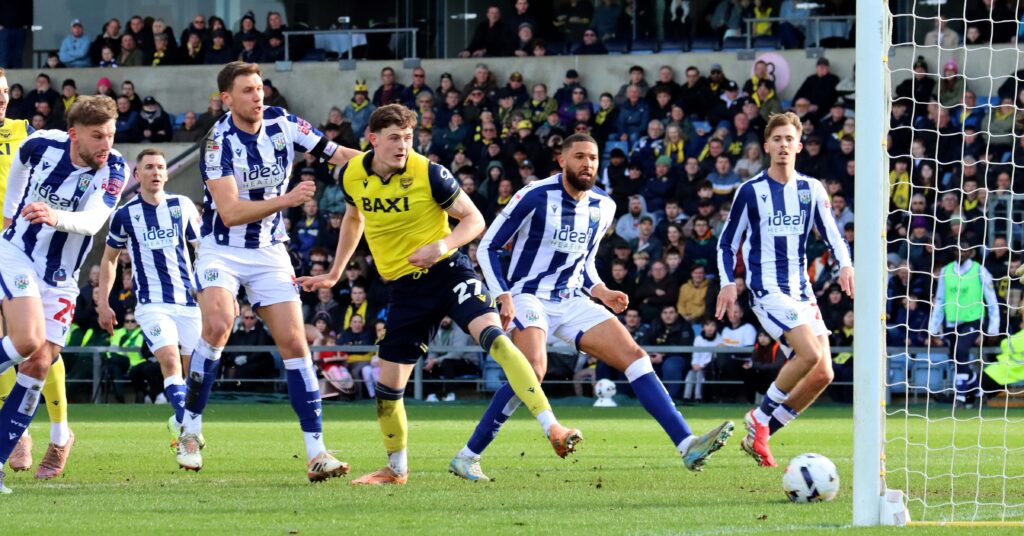
Leading scorer and all-round good guy Will Lankshear scoring against West Brom (Photo: Steve Daniels)
After two seasons in the Championship, United find themselves back in League One. It was (kinda) fun while it lasted, but it always felt inevitable that it would be a fleeting adventure, due to a number of factors.
First, it felt like promotion – via that incredible day at Wembley – took the club a bit by surprise. The squad hadn’t been built with Championship football in mind, meaning that the U’s were always playing catch-up to build a squad that was at a minimum able to compete with the team’s new peers.
In addition, there was a lack of Championship experience in the building and it took a while to work out the levels required. It cost Des Buckingham his job and it wasn’t until Gary Rowett was appointed that this issue was addressed. Unfortunately, Rowett was a victim of his own success; having kept Oxford up in his first half-season, the expectations for his second season led to an optimism that was never likely to be fulfilled.
Of course, there were also extenuating circumstances that led to the side’s eventual relegation last season. All teams have injuries with which they have to deal, but United’s injury list was not only lengthy, it also affected many players who were instrumental in how the club played, such as Brian de Keersmaecker, Cameron Brannagan, Tyler Goodrham, Przsemysłav Płacheta, Jack Currie, and many others at various times.
There was also the record-breaking run of games without a penalty, eventually reaching 92 matches before a spot kick against Charlton Athletic was finally awarded, converted (of course) by Brannagan. While also being a statistical anomaly, there were more than a few occasions when good shouts for a penalty were waved away. So much so that the Charlton award came as a surprise to everyone, even though it was a cast-iron pen. Needless to say, United threw away two points by needlessly conceding a penalty themselves in the closing minutes.
So, despite the likelihood of relegation becoming a certainty before the penultimate game, against Sheffield Wednesday, could we consider the 2025/26 season a failure? Well, given that the remit of both Rowett and his successor Matt Bloomfield would presumably have been to retain the club’s Championship status, it was a clear failure.
As such, who should be held accountable? Difficult question, and there are no simple answers, always assuming that accountability (or, in other words, blame) should be sought.
The two managers are the obvious ones requiring scrutiny. Rowett certainly failed to live up to expectations, and he was partly the architect of his own downfall. His team selections were frequently questionable; his tactics – so effective last season – didn’t seem to be particularly effective second time around; and, especially towards the end of his tenure, his whole demeanour seemed to suggest that pitchside was the last place he wanted to be. That might be (almost certainly is) untrue, but it would have had an effect on the players and certainly the fans.
Bloomfield came in with, perhaps, lower expectations, although the January transfer-window activity seemed to suggest that the club was prepared to give him the necessary tools for survival. And initially it looked like their confidence was well placed. But for a couple of blatant misses by Stan Mills against Bristol City and QPR, Oxford could have won his first three games in charge, followed as they were by the victory at Leicester.
However, the side then reverted to type, failing to win any of their next seven games (although these included impressive draws at both Coventry and Middlesbrough). There was nevertheless the opportunity to remain a Championship side as the U’s then won three on the bounce for the first time this season, including against relegation rivals West Brom and Blackburn.
That the side failed to take advantage remains a point of disgruntlement, with dropped points – especially against Charlton, Portsmouth, and Hull (the first two from winning positions) – from winnable games especially disappointing. It was kind of a relief when relegation was confirmed before the Sheffield Wednesday game, and the fact that it happened due to results elsewhere maybe softened the blow somewhat. In fact, that Wednesday game was notable for being the first double United have achieved in these two Championship seasons, the first brace in that period (leading scorer Will Lankshear scoring the first two goals), and the side’s biggest margin of victory over that time. All too little, too late, of course.
Also having to shoulder their fair share of the blame are the players, of course. There were too many missed chances, too many defensive errors, not enough collective responsibility, and far too many misplaced passes. It’s probably not unreasonable to say that, for large periods, the players let themselves down. There were enough players of the required standard that failed to meet the demands of Championship football regularly enough to keep the side above the dotted line.
Which leads on to the recruitment. Were the players signed of the required calibre? Were there enough of them brought into the building? Was there a dialogue between the head coaches and the recruitment department? Easy to say in hindsight, but the answers to all three questions is probably no.
The first Championship transfer window saw a large number of players signed, many of whom would barely feature. Indeed, in the first game at this level, the 2-0 win against Norwich, nine of the starting 11 were player that were involved in the play-off win over Bolton in League One. Fair enough, they deserved to be given a go, and the two new faces – Płacheta and Will Vaulks – both played well enough.
However, it soon became clear that it was a case of quantity over quality, not really rectified in the January window, when players signed included Tom Bradshaw and Ole Romeny. Then there was the strange close-season window, when two top-quality players in De Keersmaecker and Brodie Spencer joined on permanent deals, and that was just about it (although the loan acquisition of Lankshear from Spurs was absolutely inspired).
This January, some of the mistakes of the previous windows were partially rectified. Yunus Konak was arguably the highlight, although Jamie McDonnell, Christ Makosso, and Aidomo Emakhu also added to the squad. Myles Peart-Harris had his detractors, but his three goals lifted him to joint-third top scorer.
So, while the recruitment team has questions to answer, I think it’s too simplistic to claim that this is where the root cause of the side’s troubles lie. Recruitment is not an exact science, and players that thrive at one club may well fail to prosper at their next port of call (and vice versa, of course). This could be due to many factors but I think it’s reasonable to say that the side’s recruitment was the proverbial curate’s egg: good in parts.
There was also, let us not forget, the shitshow that was the Indonesia tour at the start of pre-season. United were probably expected to win the President’s Cup at a canter, but a mix of the appalling weather conditions, the terrible pitches, and opponents whose main ambition seemed to be to see how many Oxford players they could crock, meant that the whole expedition led to a poor start to the season. Yes, Rowett, may have got a ride on a lion cushion and the sightseeing was probably fun, but overall the whole affair was a bit of an embarrassment. However, to claim that this was a major factor in the side’s relegation is probably to overstate the effect of the tournament.
In conclusion, there were many factors in the club’s failure to stay up, and they probably have roughly equal weighting. The only positive to come out of the whole affair is that the club should be a lot wiser and know what Championship survival takes next time around (whenever that might be).
As for next season in League One, it’s difficult at this stage to know what it holds in store. Clearly there needs to be some sort of rebuild of the Oxford squad, and this has started with the news that none of the out-of-contract players will be re-signed. There will also be a number of contracted players that the club will be keen to move on, while it’s entirely possible that others may be sought after elsewhere. One would also hope that the club has the wherewithal to bring in the players required to make next season competitive, at the very least.
It won’t be the walk in the park that some supporters might expect or hope for. There will be some strong, and well-resourced, sides in League One, including whichever of the sides in the play-off positions fail to go up (with the possible exception of Stevenage, whose promotion challenge may well be their one season in the sun).
Whatever happens during the summer, one thing is certain: we’ll be there to do it all again in 2026/27, by when hopefully the new stadium will be well under way.
UTFO
© Rage Online 1998 - 2026 All rights reserved. If you want to copy stuff, please quote the source
another fine mash from ox9encoding